The Teachers Together English team understands the importance of accurately assessing a student’s English language proficiency level. Utilizing the Common European Framework of Reference for Languages (CEFR) can be a life-changing tool for you, whether you are an experienced teacher or you have just embarked on your teaching career. This structure presents a universal procedure for evaluating communication competencies, which in turn facilitates each student to receive the appropriate amount of instruction.
[ex-toc]
What are CEFR Levels?
The CEFR is a global standard related to language proficiency, which is categorized across six levels from A1 (beginner) to C2 (mastery). These levels help educators design curriculum and assessments that are tailored to each student’s abilities.
| Level | Description |
|---|---|
| Pre-A1 | Basic understanding and use of simple expressions. |
| A1 | Can understand and use familiar everyday expressions and simple phrases. |
| A2 | Can understand sentences and frequently used expressions related to areas of most immediate relevance. |
| B1 | Can understand the main points of clear standard input on familiar matters. |
| B2 | Can understand the main ideas of complex text on both concrete and abstract topics. |
| C1 | Can understand a wide range of demanding, longer texts, and recognize implicit meaning. |
| C2 | Can understand with ease virtually everything heard or read. |
Assessment Tools for Accurate Placement
All members can access our free evaluation tools including those on the free plan. These tools consist to help you to choose the right starting point for each student.
General Assessment
It is this tool that assesses the three skills: reading, listening, and speaking. In addition, it gives a whole picture of the student’s proficiency and guarantees them to be placed in the appropriate level. Based on the student’s performance on the general assessment, you will be able to place the student in the corresponding level of Teachers Together English and CEFR.
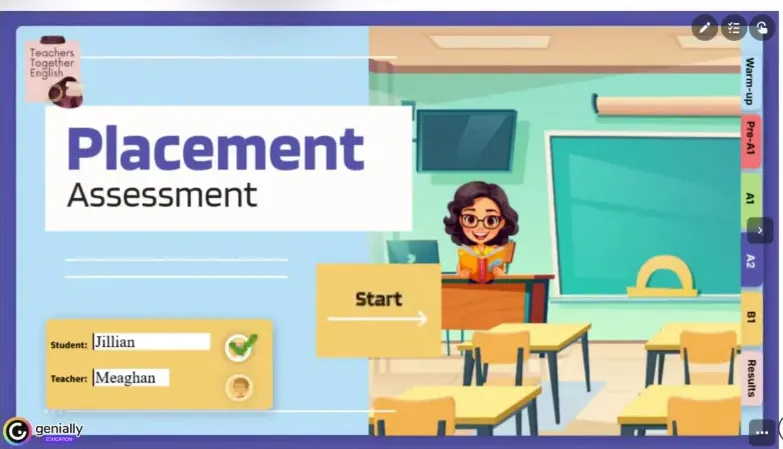
Writing Assessment
The writing evaluation is aimed primarily at assessing the learner’s ability to convey thoughts in their own and written form. It includes three writing tasks that get progressively more challenging. Descriptive language, opinion writing, creativity, coherence, and the use of linking words are among the skills that it targets.

Using the Results
Following the completion of an assessment, you can make a lesson plan with the help of the findings derived from it. This feature enhances communication and keeps parents informed about their child’s development. The learning plan templates that we provide will help you in informing the parents about the results, thereby, promoting collaboration and transparency.
Flexible Learning Paths
Students are not always able to fit into the pre-defined boxes. Our curriculum allows flexibility, enabling you to tailor lessons to each student’s unique needs and interests. Encourage students to explore topics that intrigue them, fostering a love for learning.

Join Teachers Together English
Join us at Teachers Together English to access these invaluable resources and more. Our community of educators is committed to providing high-quality, engaging English education for all learners.
Not a member yet? Get started with our Free Trial and explore the comprehensive resources available to our educators.
Don’t have time to watch the replay? Explore the assessment tools yourself and read more about the insights shared during the conversation between Meaghan and Jillian on the Independent Teacher Academy.
