How to Choose an ESL Curriculum as an Independent Online Tutor
There are two kinds of ESL curriculum for online tutors. One is a structured program that moves a student level by level, with placement and assessment built in. The other is a lesson library that gives you ready-made lessons and leaves the sequencing to you. Most disappointment with a curriculum comes from buying the second while expecting the first.
Names the competitorsNo prices, they changeSays where we are not the fit
What is the difference between an ESL curriculum and a lesson library?
A curriculum tells you what to teach next. A lesson library gives you lessons and leaves that decision to you. That one difference decides how much planning you still do every week.
The test is simple. Can you place a new student, teach the next lesson in a sequence, send matching homework, and reassess later to show progress, all without leaving the product? If yes, it is a curriculum. If you are choosing from a catalog each week and tracking progress in your own spreadsheet, it is a library, however large.
Libraries are not worse. A tutor who teaches adult conversation, or who customizes every course, may prefer one. But a tutor teaching children, beginners, or anyone whose parents expect visible progress needs the sequence more than the volume.
What should an ESL curriculum for online tutors include?
Six things, and the last three are where most products fall short. The first three are about the lesson; the last three are about everything around it, which is where a tutor’s unpaid time goes.
A level sequence, so the next lesson is a choice between two or three, not two hundred.Materials built for screen share, where the student has to say, choose, type or point every few minutes.A placement test, so a new student starts in the right place.Homework that practices the same language as the lesson, ready to send.A way to show progress to a parent or an adult learner without building a spreadsheet.Teacher notes, so a lesson you have never taught still runs cleanly.
Which ESL curricula do independent tutors actually use?
Six products come up in almost every comparison, plus this one. They differ mainly in learner age, whether they are structured or a library, and how much assessment and tracking they carry. Prices are left out on purpose: they change, and a stale price is worse than none.
| Product | Learners | Structure | Around the lesson | Best for |
|---|---|---|---|---|
| Off2Class | Teens and adults | Structured, step by step | Placement tests, homework, unit checks, student dashboards | A tutor who needs measurable progression for adults or older teens |
| Ellii | Children to adults | Large library, flexible rather than one path | Lesson planner, student accounts, reporting | A tutor who wants breadth and builds their own sequence |
| Abridge Academy | Kids to younger teens | Structured, interactive slides | Workbooks; limited learner analytics | Young learners, with Cambridge-oriented material |
| Crystal Clear ESL | Kids, teens and adults, by library | Ready-to-use curricula, gamified | Interactive web lessons; limited analytics | Gamified one-to-one lessons for younger learners |
| ESL Brains | Teens and adults | Topic based, not linear | Video-led lessons and discussion tasks | Adult conversation and contemporary topics |
| ESL Pals | Kids to adults | Library with level-based options | Downloadable plans, worksheets, tests | A tutor who prefers printable material and customizes it |
| Teachers Together English | Kids to teens | Six levels, Pre-beginner to Advanced | Placement, homework, feedback and tracking inside The Tutor Resource | A tutor teaching kids and teens one to one who wants the whole loop in one place |
Off2Class is the closest thing to a complete system for adults. Abridge Academy and Crystal Clear ESL are the strongest visual, interactive options for young children. Ellii and ESL Pals are libraries first, with useful planning tools around them. ESL Brains is the pick for adult discussion. Teachers Together English sits with Off2Class on structure and assessment, and with Abridge on age.
Which ESL curriculum is best for kids, teens, or adults?
Choose by age before anything else, because a beginner lesson for a seven-year-old and one for a thirty-year-old share a language target and almost nothing else. Kids need two to five minute activity cycles, visuals, songs and routines. Teens need topics tied to their interests and a tone that does not feel childish. Adults need real-life relevance and goals they can see.
For children, Abridge Academy, Crystal Clear ESL and Teachers Together English are the structured options. For teens, Teachers Together English carries the progression through to advanced; Off2Class and Ellii also serve teens well. For adults, Off2Class for progression and ESL Brains for conversation. For business English, ESL Brains, ESL Pals or Off2Class.
The honest gap on this site: the six levels here are a kids-to-teen progression. If you mainly teach adults for work, Off2Class or ESL Brains will fit you better today. An adult track exists and is not on these pages yet.
Do online ESL lessons need to be interactive, or are PDFs enough?
For live one-to-one teaching, interactive web materials work better than PDFs, because the tutor and the student work on the same screen. A PDF can be made to work over Zoom with a whiteboard and annotation, but you are then building the interactivity yourself every lesson.
The rule that matters more than the format: the student should be producing language for at least half the class. A lesson that only gives the tutor slides to read from saves planning time and does nothing for the live lesson. A good online lesson runs warm-up, presentation, guided practice, production, wrap-up, with most of the minutes in the last three.
For the warm-up and the production stage, see twenty-one warm-up and speaking activities that work on a shared screen.
How do you test an ESL curriculum before paying for it?
Teach three lessons from it, not one: a beginner lesson, an intermediate lesson, and a review lesson. One good sample lesson tells you about the sample; three across the range tell you about the curriculum.
Judge each one by a single standard. Does it make the student speak, choose, type or explain something every few minutes? Then check the things a sample lesson hides: whether there are teacher notes, whether homework matches the lesson, whether the next lesson is obvious, and whether the materials load on your students’ devices and connections. Any product worth paying for has a free way to run this test.
Before the three lessons, place the student. CEFR levels explained covers what each level looks like in a lesson and how to assess one in five minutes.
How does Teachers Together English compare?
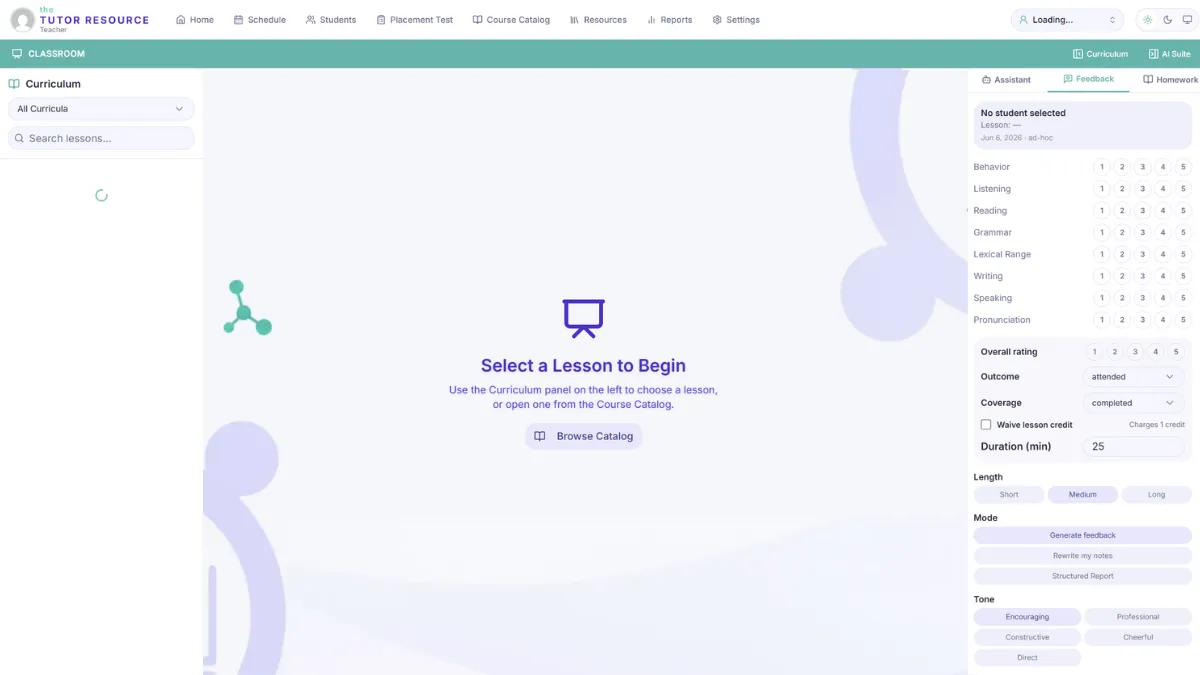
It is a structured curriculum, not a library: six levels from Pre-beginner to Advanced for kids and teens, hundreds of ready-to-teach lessons built for screen share, in use with online tutors since 2021. It now lives inside The Tutor Resource, which adds the placement test, homework and feedback generation, student tracking and scheduling, so the whole loop from placement to progress report happens in one place.
It was built by a working tutor, teaching one to one online every day, and every lesson was taught to real students before it was published. That is the reason it exists and the reason it is shaped the way it is: the lessons make the student do something on every screen, because a lesson that does not fails in front of a seven-year-old within minutes.
Where it is not the fit: adults who need business English or exam preparation, and tutors who want a very large library to sequence themselves. Off2Class, ESL Brains and Ellii serve those tutors better. Where it is: a tutor teaching children or teenagers one to one, who wants less preparation and something to show a parent at the end of the month.
Common questions
Run the three-lesson test on this one
A free account is enough to teach a beginner, an intermediate and a review lesson from the curriculum, and to run the placement test on a student. No card, and nothing to cancel if it is not the fit.