How to Teach English to Beginners Online: What to Teach First
A complete beginner needs a small amount of language they can use tomorrow, taught in patterns rather than rules, in English, with a picture for everything. This page gives the starter order every beginner course follows, a lesson plan for an A1 class, the patterns that come before grammar, when phonics starts, and the games and questions a beginner can actually manage.
Kids and adultsNo translation neededFive to eight words a lesson
What should you teach a complete beginner first?
Concrete, high-frequency language the learner will use in their own life this week, in patterns they can repeat rather than rules they can explain. Every published beginner course starts in roughly the same place, for the same reason: greetings, feelings, numbers and colors, family, everyday objects, likes, and the daily routine.
The order below is that common order, and it is the shape of the first two or three months for a child with one or two lessons a week. What changes between courses is not the topics but how well each one makes the learner speak, which is the next section.
Greetings and names
Hello, goodbye, my name is, what is your name. The learner has a first exchange they can complete in the first ten minutes, and every lesson from now on opens with it.
Feelings
Happy, sad, tired, hungry, with a face for each. “I am happy” is the first full sentence most beginners say, and it is the one they will use every day.
Numbers and colors
One to ten and six colors. They are concrete, they are everywhere, and they combine with every noun that comes later.
Family
Mother, father, brother, sister, the people the learner will want to talk about before anything else. “This is my” arrives here.
Everyday objects
Things in the room, in the bag, on the table. Point, name, “it is a”, “where is the”. This is where a beginner starts building sentences rather than reciting words.
Likes and dislikes
“I like”, “I do not like”, with food and animals. The first opinion, and the first time a learner says something true about themselves that you did not feed them.
Daily routine
Wake up, eat breakfast, go to school, sleep. Present simple arrives as a pattern, not a rule, and the learner can now describe a day.
How do you teach English in English to a beginner?
Show, do not explain. Every new word gets a picture, a gesture or an object, said three times, and the learner says it back before anything is written. Instructions are the same five phrases every lesson, look, listen, say, point, your turn, until they are understood without thought. You never need the learner’s language for a concrete word, and a beginner’s first months are almost entirely concrete words.
Grade your own speech harder than feels natural. Short sentences, the same sentences, slower than conversation, and a pause after every question that lasts longer than is comfortable. The most common reason a beginner lesson stalls is not the learner’s English; it is the tutor’s.
A single translated word, given once, is not a failure. It is a tool for the abstract word you cannot draw. What loses the learner is translating everything, because then they listen for the translation and never for the English.
What does a beginner ESL lesson plan look like?
Thirty-six minutes of a forty-five minute class in six stages, with the learner speaking in five of them. The shape is the same as any lesson, warm-up, review, new language, guided practice, production, wrap-up, compressed for an attention span and padded with routine.
The stage most tutors cut when time runs short is production, and it is the one that matters. If the lesson is running long, cut new language instead: five words practiced beat eight words presented.
Greeting exchange, then one feeling. The same every lesson, so the learner starts by succeeding.
Last lesson’s five to eight words, as a game. If they are gone, this becomes the lesson and the new words wait.
Five to eight new words or one new pattern, with a picture and a gesture for each. Say it, show it, they say it, three times.
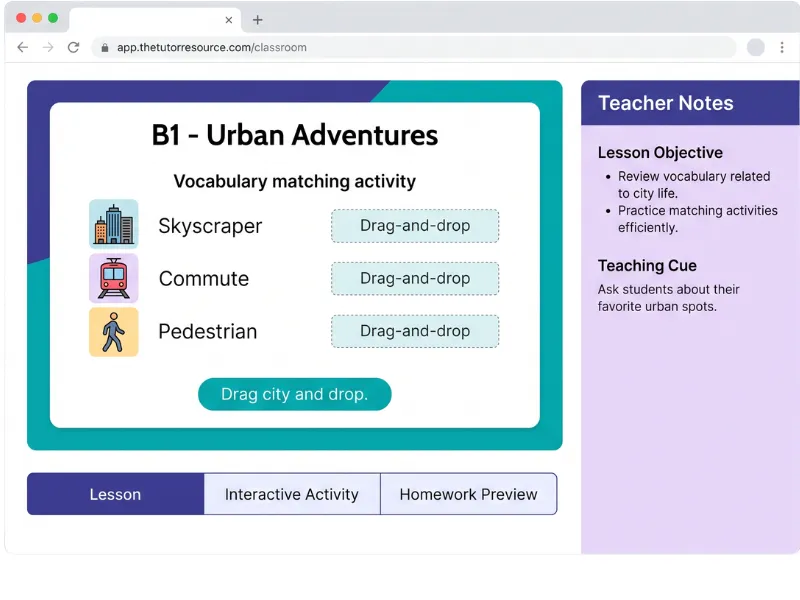
Matching, pointing, choosing, drag to the picture. You give the frame, they fill it. Accuracy matters here and you correct gently and immediately.
They say two or three sentences with the new language about something real: their pet, their bag, their family. Meaning matters here and you let small errors go.
Say three of today’s words back to you, one sticker or point, one tiny homework: color the picture and say the words to a parent.
For the warm-up and production stages, twenty-one warm-up and speaking activities that work on a shared screen, with levels and minutes.
Which sentence patterns should a beginner learn before any grammar?
Seven, and they cover most of what an A1 learner says. Each is taught as a thing to say with a slot for the word, not as a tense. The negative and the question come a few lessons after the statement, once the statement is automatic.
Teach them in this order and the grammar arrives on its own: by the time a learner has I am, I have and I like, they are using the present simple, and by the time they can ask Do you like? they are using auxiliaries. Naming those things can wait a year.
I am. Then I am not, then Are you? Feelings, names, ages.This is, that is. Then What is this? Objects, family, pictures.I have, I do not have. Then Do you have? Possessions, pets, family.I like, I do not like. Then Do you like? Food, animals, colors.Where is? With in, on, under. Objects in a picture, then the room.Can I? Then Can you? Classroom requests first, then abilities.There is, there are. Counting things in a picture, then in the room.
When should phonics start for a beginner?
From the first weeks, alongside the words, and never instead of them. Two or three letter sounds a lesson, tied to words the learner already knows, so the sound has a meaning attached. Sounds before letter names: a child who knows that c says the sound in cat can read; one who knows it is called “see” cannot.
For a child, phonics is the long game and it runs through the first two years. For an adult who already reads a Latin alphabet, it is a few weeks of the sounds English spells strangely, and then it is done. For an adult coming from a different script, treat it like a child’s phonics, patiently and from the start.
Which beginner ESL games work online?
Games that make the beginner retrieve a word or say a pattern, not games that fill time. A beginner can play very few games, because most games need language they do not have, so choose ones where the language is the point and the rules are one sentence long.
Point to, show me
You name it, the child points or fetches it. Movement plus listening, and no output needed until they are ready.
Category race
“Five things that are red”, a timer on screen, one word each. Retrieval under light pressure, which is how words become theirs.
Picture reveal
A picture hidden under squares, one removed per correct word. Vocabulary retrieval with a reason to keep going.
Feeling, then why
Six faces, pick one, say the sentence. At the very beginning, the sentence alone; later, add because.
Show and tell
One object to the camera, three sentences about it. The first time a beginner speaks about their own life unprompted.
Which conversation questions can a beginner actually answer?
Ones built on a pattern they have, with a yes, a no, a number, a color or one word as a complete answer. Open questions, what did you do, why do you think, are for A2 and above. These twelve cover a beginner’s first months, and each one becomes a question the learner can ask you back.
Do beginners need worksheets?
For homework, yes; in an online lesson, mostly no. A worksheet on a shared screen becomes a tutor reading and a learner watching. The same content as a screen task, point to the picture, drag the word, choose the one that is red, keeps the learner doing something every minute.
Where a worksheet earns its place is after the lesson: one page, the same words, colored or traced or matched, then said aloud to a parent. That is the review that makes next week’s warm-up work.
How long does it take a beginner to reach A1?
About 90 to 100 guided learning hours by Cambridge’s estimate, which at two lessons a week with homework is roughly a school year. A child with one lesson a week and no exposure takes longer; a motivated adult with daily practice takes less.
The tell that a learner has arrived is not a test score. It is the first time they answer a question you did not rehearse, in a sentence, about themselves.
What A1 and the levels above it look like in a lesson, and how to place a student: CEFR levels explained.
Where do the Teachers Together English beginner levels fit?
The first three of the six levels are the beginner stretch: Pre-beginner for a learner with no English, Basic beginner for one who has some words and needs patterns, and Beginner for one ready to use fuller everyday language. Each lesson is built to the shape above, with the warm-up, the picture for every word, and the production task already in it.
They are for kids and teens, taught one to one on a shared screen. An adult beginner learns the same language and needs a different world around it; the adult track is not on these pages yet.
Common questions
Beginner lessons with all of this built in
Three beginner levels for kids and teens, every lesson with the picture, the pattern, the game and the homework already there. A free account is enough to teach a few and see whether it fits.