
CEFR Levels Explained for ESL Tutors: A1 to C2, and How to Place a Student
The CEFR is a six-level scale for describing what a language learner can do, from A1, a complete beginner, to C2, near-native mastery. Cambridge estimates roughly 90 to 100 guided learning hours to reach A1 and 1,000 to 1,200 to reach C2. This page says what each level looks like in a real lesson, how the levels map to the exams your students ask about, and how to place a new student before the first class.
Council of Europe scaleCambridge and IELTS mappingsFree placement test
What are the CEFR levels?
The Common European Framework of Reference describes language ability on six levels, A1, A2, B1, B2, C1 and C2, grouped as basic user, independent user and proficient user. A seventh, Pre-A1, was added for learners, mostly children, who are below the first rung. Each level is defined by what the learner can do, not by which grammar they have covered.
The table gives the level, its Council of Europe name, what the learner can do in one line, the Cambridge exam pitched at it, the IELTS band Cambridge maps to it, and Cambridge’s estimate of guided learning hours to reach it from zero. The hours are cumulative and they are estimates; a motivated adult with homework and daily exposure beats them, a child with one lesson a week does not.
| Level | Name | Can do | Cambridge exam | IELTS | Hours to reach |
|---|---|---|---|---|---|
| Pre-A1 | Starter | Single words, set phrases, greetings. Understands very slow, repeated speech about familiar things. | Pre-A1 Starters (young learners) | below 4 | the first 90 or so |
| A1 | Breakthrough | Introduces themselves, asks and answers simple personal questions, follows slow clear speech. | A1 Movers (young learners) | 4 | 90 to 100 |
| A2 | Waystage | Handles routine exchanges: shopping, directions, family, work in simple terms. Understands short clear messages. | A2 Key (KET), A2 Flyers | 4 to 5 | 180 to 200 |
| B1 | Threshold | Copes with most situations while travelling, describes experiences and plans, gives short reasons for opinions. | B1 Preliminary (PET) | 5 to 5.5 | 350 to 400 |
| B2 | Vantage | Follows the main ideas of complex text, speaks fluently enough for a natural conversation with a native speaker, argues a point. | B2 First (FCE) | 5.5 to 6.5 | 500 to 600 |
| C1 | Effective operational proficiency | Uses language flexibly for social, academic and professional purposes, produces clear well-structured text on complex subjects. | C1 Advanced (CAE) | 7 to 8 | 700 to 800 |
| C2 | Mastery | Understands virtually everything heard or read, expresses themselves precisely and spontaneously, even in complex situations. | C2 Proficiency (CPE) | 8 to 9 | 1,000 to 1,200 |
What does each CEFR level look like in a lesson?
The descriptors are written for examiners. In a one-to-one lesson, each level has a recognisable feel, and each has a trap that tutors fall into.
First words and set phrases
The learner names things, answers yes or no, and produces a sentence when you give them the frame. Everything is present tense and everything needs a picture. The trap: teaching grammar. An A1 learner needs words and patterns they can use tomorrow, not the rule behind them.
Routine exchanges, past tense arriving
The learner can get through a shop, a doctor, a description of their weekend, with errors you can understand through. The trap: mistaking a good memory for A2. A learner who recites twenty phrases perfectly but cannot answer an unexpected question is still A1.
Coping in the real world
The learner narrates, explains a problem, gives reasons, and survives a trip abroad. This is the level most adult learners plateau at, because it is enough. The trap: letting the lesson become chat. B1 needs new language every week or it stays B1 for years.
Independent and fluent enough
The learner holds a natural conversation, argues a point, reads a newspaper. Universities and employers usually mean B2 when they say “good English”. The trap: correcting everything. B2 learners make many small errors that do not block meaning; pick the ones that do.
Precision and range
The learner adapts register, handles the abstract, and rarely has to search for a word. Lessons at this level are about nuance, idiom, and the difference between correct and natural. The trap: running out of material. Most curricula stop at B2; C1 needs authentic texts and a tutor who reads.
Why do CEFR levels matter for a one-to-one tutor?
Three reasons, and the third is the one that keeps students. First, placement: a student started one level too high spends a month discouraged, and one started too low spends a month bored, and both leave. Second, materials: nearly every published resource is labelled by CEFR level, so knowing the level is how you choose. Third, evidence: “your daughter has moved from A1 to A2” is a sentence a parent understands and pays for another term on. “She is doing really well” is not.
The framework also lets you talk to schools, exam boards and other tutors in the same language. A learner described as “B1, weaker in writing” means the same thing in Madrid, Tokyo and Toronto.
How do you assess an ESL student’s level?
Listen for what the learner can do, not what they get wrong. A five-minute conversation with one probe question per level places most students within a level, and an adaptive placement test confirms it and breaks it down by skill. Use both: the conversation tells you about speaking, which a test cannot, and the test tells you about reading and grammar, which a conversation hides.
The probe questions below go up one level at a time. Stop when the learner cannot do the thing, and place them at the last level they could. Do not place on grammar knowledge: a learner who knows the rule for the present perfect and cannot tell you about their weekend is A1, whatever the grammar book says.
A1: “Tell me about your family.” A learner who can name three people and say one thing about each is at least A1. One who answers “mother, father” and stops is Pre-A1.A2: “What did you do last weekend?” A2 can tell you, in the past tense, with errors. A1 answers in the present, or with a list of nouns.B1: “Tell me about a problem you had recently and what you did.” B1 can narrate it and give a reason for the decision. A2 gives you the event and no reasoning.B2: “Some people think children should not have phones. What do you think?” B2 argues both sides and lands somewhere. B1 gives an opinion and one reason.C1: “Explain something from your work or studies to me as if I knew nothing about it.” C1 restructures the idea for the listener. B2 explains it the way they learned it.
How do you place a student who is between levels?
Place them at the lower level, and place on speaking. Skills are uneven: a learner who reads at B1 and speaks at A2 will fail a B1 speaking lesson every week and succeed at A2 with a stretch. The lower placement gives you a student who wins in the first lesson, which is the placement that keeps them.
The exception is an adult with a specific goal, an exam date or a job interview, who needs to work at the target level regardless. Tell them the gap honestly, place at the level they need, and expect the first month to be hard.
How long does it take to move up a CEFR level?
Roughly 100 guided hours for the first level and 150 to 200 for each level after that, by Cambridge’s estimates, so A2 to B1 is about 200 hours and B1 to B2 about the same again. At two one-hour lessons a week with homework, that is close to a year per level from A2 onward.
Two things shorten it: daily exposure outside the lesson, and homework that practices the same language as the lesson rather than something new. Two things lengthen it: lessons that are conversation with no new input, and a level pitched too high, where the learner spends the hour surviving rather than acquiring. Children move faster on speaking and slower on writing, and an hour of a child’s lesson is not an hour of an adult’s.
For the first of those hundred hours, how to teach English to beginners covers what to teach first and the shape of an A1 lesson.
Does the CEFR work for children?
Yes, with care. The framework was written with adults in mind, and a seven-year-old will never “discuss the advantages of a policy”. The Pre-A1 level and the young learner exams, Starters, Movers and Flyers, exist because of that, and they cover the range most children in tuition sit in: Pre-A1 to A2, with B1 for older or long-established learners.
The rule for children: read the can-do statements as a child would do them. “Can describe their family” at A1 means naming people and saying one thing about each, in a child’s world. Do not expect abstract reasoning at B1 from a ten-year-old who cannot yet do it in their first language, and do not mark them down for it.
How does Teachers Together English use the CEFR?
The six levels here are described by stage, Pre-beginner through Advanced, rather than stamped with a single CEFR band each. That is deliberate: a child’s profile across skills is uneven, and a letter on a level page overstates the precision. The placement test inside The Tutor Resource is CEFR-aligned, adapts to the student’s answers, reports by skill, and recommends a starting level in the curriculum from the result, which is where the mapping belongs: per student, not per page.
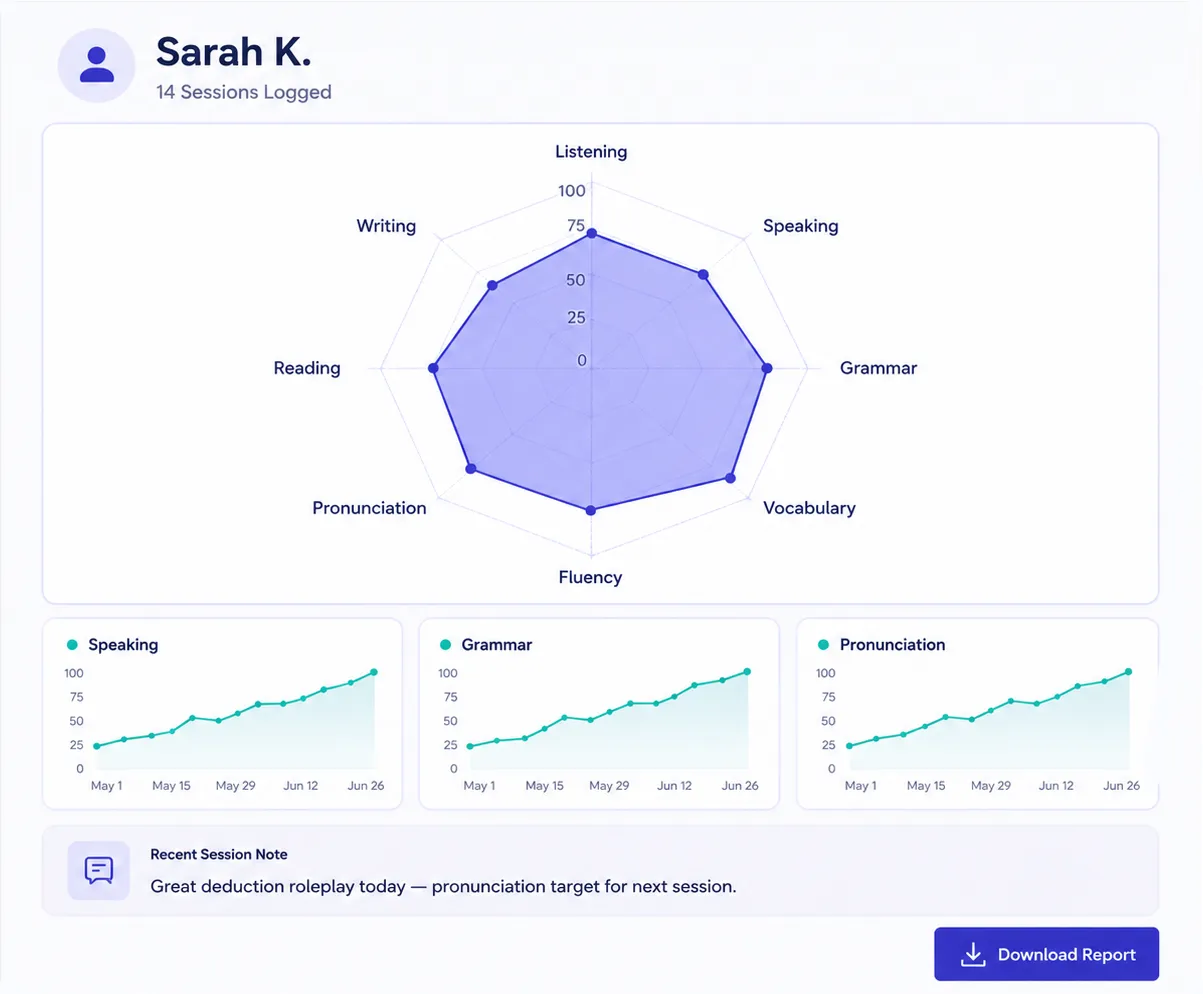
The report it produces is the one to share with a parent. It names the level, shows the skills profile, and gives them something to compare against in three months.
Place a student before the first lesson
An adaptive, CEFR-aligned placement test with a shareable report and a skills breakdown. Free to use, and it recommends where in the curriculum to start.
Adapts to the student’s answersReports listening, reading, grammar and vocabulary by skillA report you can send to a parentRecommends a starting level
Common questions
Then teach from where they are
Six levels for kids and teens, from first words to independent discussion, with the placement, homework and progress report in the same place as the lessons. A free account is enough to try it.